
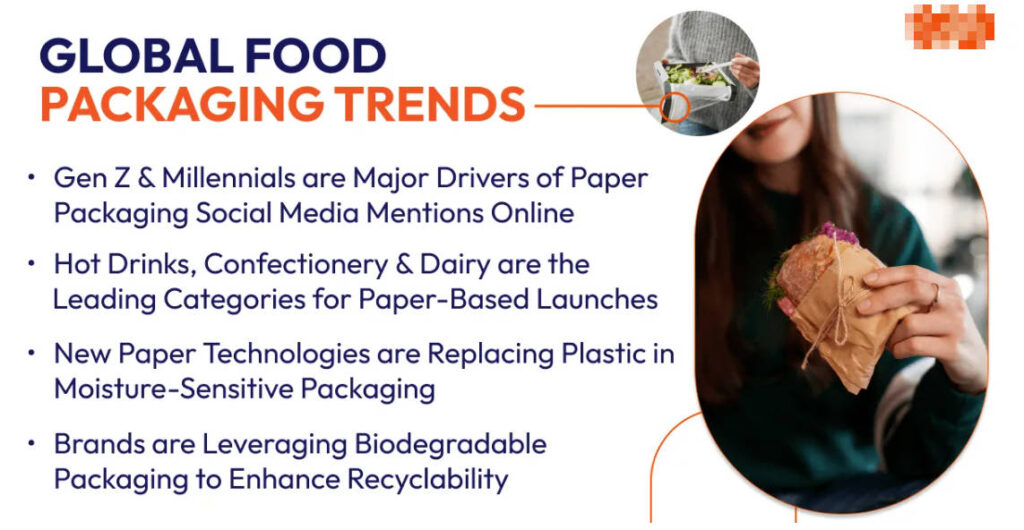
Food Packaging Trends:Global Market Overview
January 20, 2026 – The global packaging industry is currently experiencing a shift from plastics and non-recyclable products to paper-based packaging. Food packaging trends are largely driven by sustainability factors, as well as functionality and consumer interest. Innovations span across a variety of formats and technological advances, with protection, moisture resistance, and shelf-life considerations at the forefront. Innova’s ” Trending in Paper-Based Packaging in F&B- Global” analyzes the major paper-packaging trends emerging in the global food and beverage market and how these trends can be leveraged in new product development to address consumers’ values and priorities.
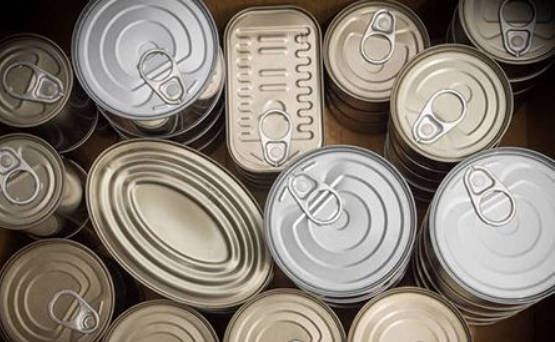
The Expansion Ring Function of the Easy Open End and Bottom End
The expansion ring strengthens can lids and maintains sealing integrity during sterilization, when internal pressure rises due to air expansion. Its design varies by can type, content, and vacuum level.
For chunky contents with low vacuum (e.g., luncheon meat, bone-in products), a stronger, more rigid expansion ring pattern is required. For liquid-rich contents with higher vacuum (e.g., clear-broth vegetables), greater resilience in the expansion ring is preferred.
Easy-open end quality significantly impacts sealing efficiency and overall production quality. High-quality can ends ensure smooth operations, consistent output, and operator confidence. Conversely, poor-quality ends disrupt production schedules and negatively affect worker morale and focus.

The History of Canned Food
Canning technology originated in 1795 when the French government offered a reward for effective military food preservation. In 1804, **Nicolas Appert** developed a method of heating food in sealed containers, earning a 12,000-franc prize in 1809. He later published *The Art of Preserving Animal and Vegetable Substances*, outlining venting, sealing, and sterilization principles. In 1810, **Peter Durand** invented tinplate cans, enabling metal container packaging, and Appert opened the world’s first cannery in 1812. The scientific basis was clarified in 1861 when **Louis Pasteur** demonstrated that microorganisms cause spoilage and validated heat sterilization. In 1874, **A.K. Shriver** introduced a high-pressure retort exceeding 100 °C, expanding product range. By the late 19th century, mechanized factories in the U.S. established modern canning based on hermetic sealing and thermal sterilization.

Food Packaging Aluminum Foil Industry Insights Report: Analyzing Market Trends, Applications, and Competitive Landscape (2026 – 2033)
Food packaging aluminum foil industry insights: highlights the rapid expansion of aluminum foil usage in food packaging driven by convenience, safety, and sustainability demands. Aluminum foil remains a preferred material due to its excellent barrier properties against moisture, oxygen, light, and contaminants, which help extend shelf life and preserve product quality. The report emphasizes growing demand from ready-to-eat meals, takeaway food, and flexible packaging formats such as pouches and lids. Sustainability trends, including recyclability and lightweighting, are accelerating innovation and investment in eco-friendly foil solutions. Regionally, Asia-Pacific leads consumption due to urbanization and rising packaged food demand. However, the industry faces challenges from raw material price volatility and competition from alternative materials. Overall, technological advancements, expanding food delivery markets, and sustainability initiatives are expected to sustain steady market growth and intensify competition among global packaging suppliers.